

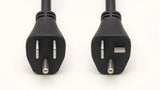
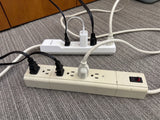
Why Overload Protection Matters: A Real Story of How a Power Strip Prevented a House Fire
A verified CRST customer in California used his power strip daily for over four years. When his extension cord overheated and began melting, the CRST power strip's built-in overload protection automatically cut power — preventing a potential house fire. This article breaks down what happened, explains how overload protection works, and covers what to look for when choosing a power strip you can trust.
Can a Power Strip Actually Prevent a House Fire?
Yes — if it has working overload protection. That's exactly what happened to Peter, a verified CRST customer in California, in March 2026. After more than four years of daily use, his CRST 15FT 2800J surge protector power strip automatically shut off when an extension cord connected to it overheated and started melting — stopping a potential fire before it started.
Peter left a 5-star review on Amazon titled "Saved my life literally!" with photographic evidence of the incident. His story is a powerful real-world example of why overload protection in a power strip isn't just a spec — it's the feature that can save your home.

Peter's verified Amazon review, posted March 18, 2026. Product: CRST 15FT 2800J Surge Protector Power Strip.
What Happened: The Full Story
During an extreme California heat wave, Peter needed to power a window AC unit mounted high on a wall — too far from any wall outlet to plug in directly. He purchased a high-power appliance extension cord from a major home improvement retailer and connected it through his CRST surge protector.
The setup ran reliably for years. Then one day, the power strip tripped for the first time. Peter reset it, but immediately noticed something wrong — a strange sound coming from the outlet, and extreme heat at the point where the extension cord connected to the power strip.
After letting the area cool, he unplugged the extension cord and discovered it had burned out and was actively melting.
His CRST power strip had already shut itself off automatically before any of that heat could ignite surrounding materials.
Photo Evidence: What a Melted Extension Cord Looks Like
Peter included two photos in his Amazon review. They show the severity of the electrical fault — and how his CRST power strip held up under extreme conditions.

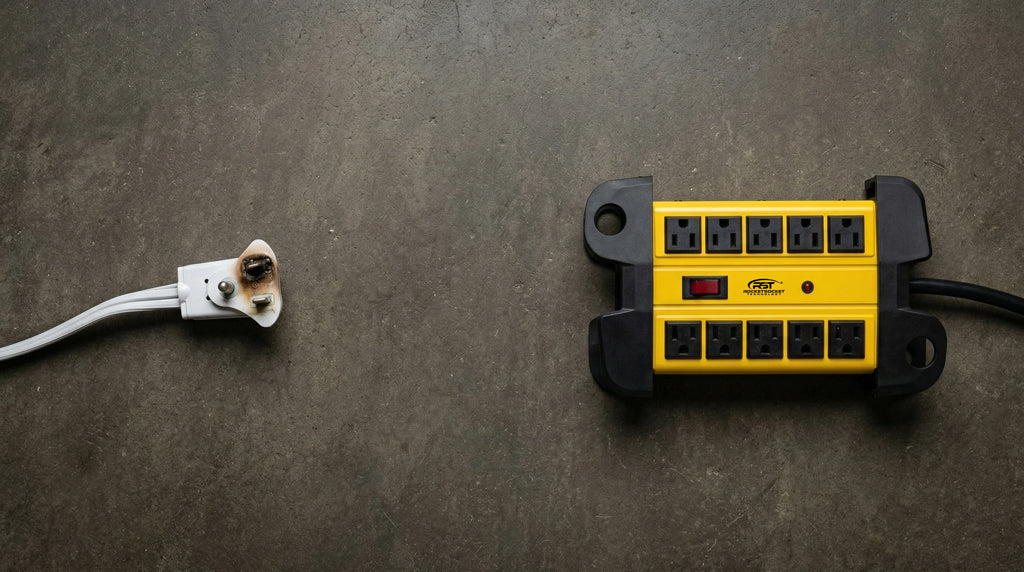
The extension cord plug after the incident — severe charring, melted housing, and deformed metal prongs. This level of heat damage can easily ignite nearby flammable materials if power is not cut in time.

The CRST power strip after the incident — the fire-resistant outlet shows only minor deformation despite extreme heat. The metal enclosure contained sparks and heat. Note the flammable carpet directly below.
The contrast between these two photos tells the whole story. The extension cord is destroyed. The CRST power strip absorbed the same heat, sustained only minor cosmetic damage, and — most importantly — cut power automatically before anything could catch fire.
The carpet visible directly underneath the power strip is a critical detail. That flammable material was inches from the fault point. Without the auto-shutoff, the outcome could have been a house fire.
How Does Overload Protection Work in a Power Strip?
Overload protection in a power strip like Peter's relies on a purely mechanical safety device: a bimetallic thermal trip circuit breaker. Inside the breaker, two bonded metals with different expansion rates form a single strip. When excessive current flows through the circuit, it generates heat. That heat causes the bimetallic strip to bend — and once it bends far enough, it physically separates the electrical contacts and cuts power to the entire strip. No electronics, no software, no batteries — just the laws of physics.
In Peter's case, the overload protection responded to an abnormal current condition caused by the internal failure of his extension cord. Here's the sequence:
1. The electrical fault. The extension cord's internal wiring degraded over time from sustained high-current draw (the AC unit). Resistance increased at the damage point, converting electrical energy into extreme heat — hot enough to melt the plug and housing.
2. The overload trigger. The excessive current generated heat inside the power strip's bimetallic thermal circuit breaker. As the temperature rose, the bimetallic strip deformed and mechanically disconnected the circuit — cutting power to the entire strip automatically, with no human intervention required.
3. The physical containment. While the circuit breaker stopped the electrical flow, the power strip's fire-resistant housing and metal enclosure physically contained the heat and sparks that had already been generated — preventing them from reaching the carpet and other nearby flammable materials.
This three-layer defense — fire-resistant materials, metal enclosure, and automatic circuit breaker — is what separates a reliable surge protector from a cheap power strip that could become a fire hazard itself.
This is why automatic overload protection matters more than manual reset buttons or indicator lights alone. A bimetallic thermal circuit breaker doesn't require anyone to be home, awake, or paying attention. It doesn't need batteries, software, or electronic components to function. It's a purely mechanical device that responds to heat from overcurrent by physically breaking the circuit — and that simplicity is exactly what makes it dependable after years of continuous service, as Peter's 4+ year experience proves. Whether the overload happens at 3 PM or 3 AM, the breaker trips the same way every time.
What Causes Extension Cord Fires?
Extension cord fires are more common than most people realize. The National Fire Protection Association reports that electrical distribution and lighting equipment — a category that includes extension cords and power strips — is involved in tens of thousands of US home structure fires every year.
The most common causes include:
- Overloaded circuits: Plugging high-draw appliances (like AC units, space heaters, or refrigerators) into cords not rated for the load.
- Cord damage over time: Internal wiring degradation from heat cycling, bending, pinching under furniture, or simply aging — exactly what happened in Peter's case.
- Daisy-chaining: Connecting power strips or extension cords in series, which compounds the risk of overheating. (Read more: Is it safe to plug an extension cord into a power strip?)
- Poor-quality components: Thin-gauge wiring, loose contacts, and non-fire-rated housings in cheaper products.
What makes these fires particularly dangerous is that the failure often builds slowly — heat accumulates over hours or days before reaching a critical point. Without overload protection that responds automatically, there may be no warning before a fire starts.
What Should You Look for in a Safe Power Strip?
If Peter's experience has you rethinking the power strip behind your desk or entertainment center, here are the features that matter most for fire prevention:
Overload protection with automatic shutoff. This is the single most important safety feature. The power strip must be able to detect abnormal current and cut power on its own — not just indicate a problem with a light. Look for a built-in circuit breaker rated at 15A for standard household use.
Fire-resistant housing. The power strip's enclosure should be made from fire-retardant materials that resist ignition even under extreme heat from an external fault — like a melting cord.
Metal construction. A metal enclosure provides physical containment of heat and sparks that plastic alone cannot match. This is especially important in environments with nearby flammable materials (carpet, curtains, paper).
A listing from a Nationally Recognized Testing Laboratory. An NRTL mark confirms the product was tested by an independent lab that OSHA recognizes, against established US safety standards — UL 1363 for relocatable power taps and UL 1449 for surge protective devices. Every CRST power strip is NRTL certified, by ETL (Intertek) or SGS depending on the model, and the certifying lab is named on each product page. A product with no NRTL listing has not been independently verified by anyone. (Here's how to check a listing yourself in three steps.)
Surge protection, read correctly. A joule rating is a capacity figure. It describes roughly how much total surge energy the protective components can absorb before they are spent — closer to a fuel tank than to a safety grade. How hard the strip clamps an incoming spike is a different property, measured under UL 1449. So treat joules as headroom, not as a protection level, and put more weight on the listing than on the number. Peter's unit is rated at 2800J, which buys generous headroom on a circuit that sees frequent transients. A joule figure with no NRTL listing behind it has not been verified by anyone.
About CRST: The Brand Behind Peter's Power Strip
CRST (by Rocket Socket Technology, Inc.) is a U.S.-based power strip and surge protector brand focused on heavy-duty electrical protection for homes, offices, garages, and workshops.
Here's what sets CRST apart:
Built on the same lines as the leading brands. CRST products come out of the same top-tier manufacturing base that produces for the industry's best-known names — the same factories, the same component sourcing standards, the same quality control infrastructure. What you pay for is the build, not the logo on it.
Premium materials and construction. Heavy-gauge internal wiring, high-quality copper contacts, fire-retardant housings, and durable metal enclosures. These aren't cost-optimized shortcuts — they're engineering choices made for long-term reliability and real-world safety, as Peter's 4+ year experience demonstrates.
NRTL certified to UL 1363 and UL 1449. Every CRST power strip is independently tested and verified by a Nationally Recognized Testing Laboratory — ETL (Intertek) or SGS, depending on the model — against UL 1363 (relocatable power taps) and UL 1449 (surge protective devices). The certifying lab is named on every product page, and certificates are issued on request. No CRST power strip ships without an NRTL listing. See how NRTL certification works for the full breakdown.
Real-world proven reliability. Peter's unit protected his home after more than four years of continuous use with a high-draw appliance. When the critical moment came, the overload protection, fire-resistant housing, and metal enclosure all performed exactly as designed.
Peter's response after the incident: he ordered a replacement from CRST immediately — because now he knows the brand delivers when it matters.
Recommended CRST Surge Protectors with Overload Protection
These are among CRST's most popular models. All four carry built-in bimetallic thermal circuit breaker overload protection, fire-resistant construction, and an ETL Listing to UL 1363 and UL 1449:
CRST 16-Outlet Metal Power Strip, 1800J, 15 ft — the highest outlet count in the range, with 2.6" ultra-wide spacing for bulky adapters. Built for home offices and workshop benches.
CRST 12-Outlet Wide-Spaced Mountable Metal Power Strip, 15 ft — full metal housing for maximum heat and spark containment, with mounting brackets included.
CRST 8-Outlet Wide-Spaced Metal Power Strip with Dual USB, 1350J — adds USB charging so phones and tablets stop occupying AC outlets.
CRST 8-Outlet Mountable Metal Power Strip, 4-Way Bracket, 2100J — four mounting orientations for workbenches, racks, and under-desk installs. (See also: how to buy a workbench power strip)
The Bottom Line
Most people don't think about their power strip until something goes wrong. Peter's story is a reminder that when that moment comes, the only question that matters is whether the protection circuit works.
His CRST power strip delivered four years of reliable daily service, then performed exactly as designed in a genuine emergency — automatically cutting power to a melting extension cord, containing heat and sparks in its metal housing, and preventing a fire on flammable carpet inches away.
That's what overload protection is for. And that's what CRST is built to deliver.
Power gear that matches the advice.
Certified by an OSHA-recognized NRTL — ETL/SGS · UL1363 & UL1449. Full-gauge copper — 14AWG on 15A models, 12AWG on 20A. 18-month warranty, free extension to 36 months on registration.
0 Comments