

Shop
20A Heavy Duty Power Strips
Shop CRST's lineup of True 20A Compliant heavy duty power strips — engineered for garages, workshops, and industrial environments where standard 15A strips fall short. All models feature all-metal housing, ETL certification, and surge protection built for demanding equipment.
NRTL certified (ETL/SGS · UL1363 & UL1449)
$3M liability insured
Ships from California in 24h
30-day money-back
2 products
Category
Everything here is currently sold out.
Picking the right one.
A few things worth getting right before you buy. None of it is brand-specific — these are the fundamentals of a power strip that lasts.
01
Outlets & spacing
Count the plugs you actually run at once, then add headroom. Widely spaced or angled outlets matter as much as the count — bulky wall-warts can block neighbors on tightly packed strips.
02
Surge rating & VPR
Joules tell you absorption capacity, but clamping voltage (VPR) and response time decide what reaches your gear. A lower VPR clamps a spike sooner — read both, not just the headline joule number.
03
Cord length & gauge
Gauge is the wire thickness. 14AWG copper carries more current with less heat and voltage drop than thinner 16AWG — it matters for power tools and long runs. Pick a length that reaches without coiling.
04
Mounting
Keyhole slots or a metal housing let a strip live on a wall, bench, or under a desk instead of underfoot. A mountable unit keeps cords off the floor and away from spills and foot traffic.
05
Certification
Look for a real NRTL mark — ETL/SGS · UL1363 & UL1449 — not a self-declared claim. NRTL listing means an OSHA-recognized lab tested the unit against the U.S. safety standard for power strips and surge protectors.
What makes a power strip actually 20 amp
Most “heavy duty” power strips are 15A devices with bold labels. A true 20 amp power strip is a different piece of hardware, and you can verify every part of it:
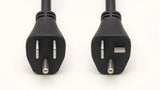
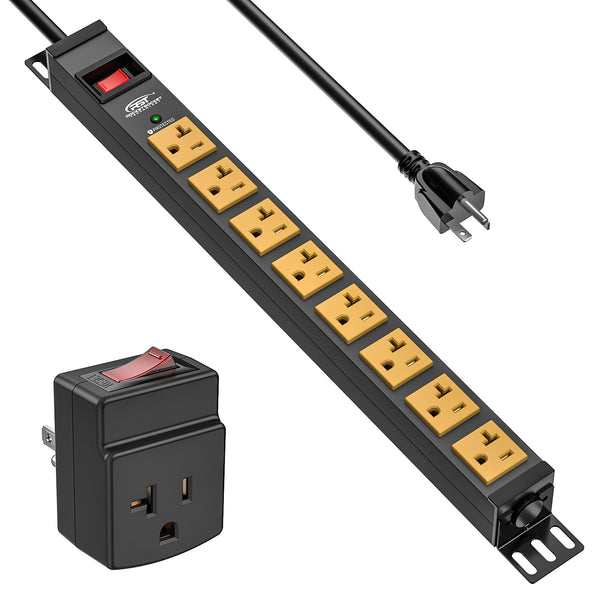
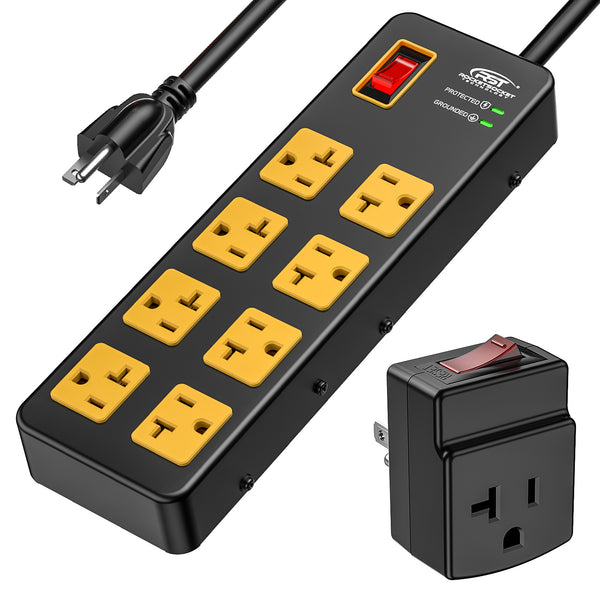
- NEMA 5-20R outlets. Look for the T-shaped slot. It accepts both standard 15A plugs and the sideways-blade 5-20P plugs on 20A equipment. All eight outlets on our 20A strips are NEMA 5-20R.
- True 20A internal wiring. The bus bars and conductors inside are sized for 20 amps continuous — not 15A internals behind a 20A faceplate.
- 12AWG cord. A 20A load needs 12-gauge copper. If a “20A” strip ships with a 14AWG or 16AWG cord, the label is writing checks the copper cannot cash.
- A 20A overload breaker. The breaker matches the rating, so protection trips at the strip’s real limit.
15A vs. 20A: what the extra amps buy you
A 15A strip tops out at 1,875W. A 20A circuit delivers up to 2,500W continuous — headroom for a workbench running a battery charging station, a shop vac, work lights, and a fan at the same time without nuisance trips. That is the difference between a strip that rides its limit and one that works inside it.
The honest part: your wall outlet matters
Full 20A capacity requires a 20A branch circuit with a 5-20R wall receptacle — common in garages, shops, and commercial spaces built to modern code. Plugged into a standard 15A outlet through the included 5-15P adapter, the strip works at 15A capacity, protected by the adapter’s built-in overload protection. You get the wide-spaced 5-20R outlets and the 12AWG build either way; the wall circuit sets the ceiling. No one selling “20A” strips should tell you otherwise.
How to spot a fake 20A strip
Check the outlet shape, the cord gauge stamped on the jacket, the breaker rating, and the certification mark — in that order. We wrote a field guide to spotting fake 20 amp power strips with photos of each check.
Certified, not just claimed
Both 20A models here are ETL Listed — independently tested by Intertek to UL 1363 and UL 1449. The lab and standards are named on each product page, and full certificates are available on request. If you are outfitting a rack or a stud wall, the 2100J model mounts to 19-inch racks and 16-inch stud spacing out of the box; the 1960J model hangs on keyhole slots. Not sure which fits your setup? Start with the buying guide or request a volume quote for multi-unit orders.
20A Heavy Duty Power Strips FAQ.
Can I plug a 20A power strip into a regular 15A outlet? +
Yes, with the included NEMA 5-15P adapter. The strip then operates at 15A capacity, and the adapter’s built-in overload protection guards the circuit. For the full 2,500W you need a 20A branch circuit with a 5-20R receptacle.
What is a NEMA 5-20R outlet? +
It is the 20A receptacle with a T-shaped neutral slot. It accepts both standard 15A plugs and the sideways-blade 5-20P plugs found on 20A tools and equipment.
Why does the cord gauge matter on a 20A strip? +
A 20A load needs 12AWG copper to run cool at full draw. Both models here ship with a 6 ft 12AWG cord. A thinner cord under a 20A label is the most common sign of a mis-rated strip.
Are these also surge protectors? +
Yes. The rack-mount model carries 2100 joules of surge protection with a status LED, and the keyhole-mount model carries 1960 joules, both with an integrated 20A overload breaker.
Who certifies these strips? +
Both are ETL Listed, tested by Intertek to UL 1363 and UL 1449. The certifying lab is named on each product page, and certificates are available on request.
Can I run a space heater on one? +
Plug high-wattage heating appliances directly into a wall outlet. These strips are built for tool benches, charging stations, and equipment racks, not for space heaters.
Not sure which to pick?
Every CRST strip is certified, insured, and built on real copper. Talk to us or read the buying guide and we will point you to the right one.