

How to Spot a Fake 20-Amp Power Strip (2026 Guide)
If your "20-amp" power strip has a standard parallel-blade plug with no horizontal prong, it is not a 20-amp strip — regardless of what the listing title claims. Real 20A strips use NEMA 5-20P plugs, carry verifiable ETL or UL certification, and rate every internal component at 20 amps, not just the cord.
Introduction
Look at the plug on your "20-amp" power strip. Are all three prongs parallel — two flat blades and one round grounding pin? If so, you are holding a 15-amp strip. No exceptions.
That single visual check separates a real 20 amp power strip from the flood of listings that swap in a thicker cord, change nothing else, and call it a day. The problem is concentrated on Amazon, where sellers in the category have figured out that "12 AWG heavy duty" reads well in a title — and that few buyers know to check the plug shape, the certification number, or the breaker rating.
This guide walks through the five verification checks that tell a real NEMA 5-20P strip from a fake, explains what a legitimate 20-amp strip actually looks like inside and out, and points you toward certified 20A options that ship with a safety adapter so you can even use one on a 15-amp outlet while a dedicated circuit is in the works.

What Makes a 20-Amp Power Strip Different — NEMA 5-15 vs. 5-20 Explained
The difference between a 15-amp and a 20-amp power strip starts in the metal. It is physical, visible, and unambiguous — and it all comes down to the NEMA configuration printed on the plug.
The Plug Shape Is the First Truth
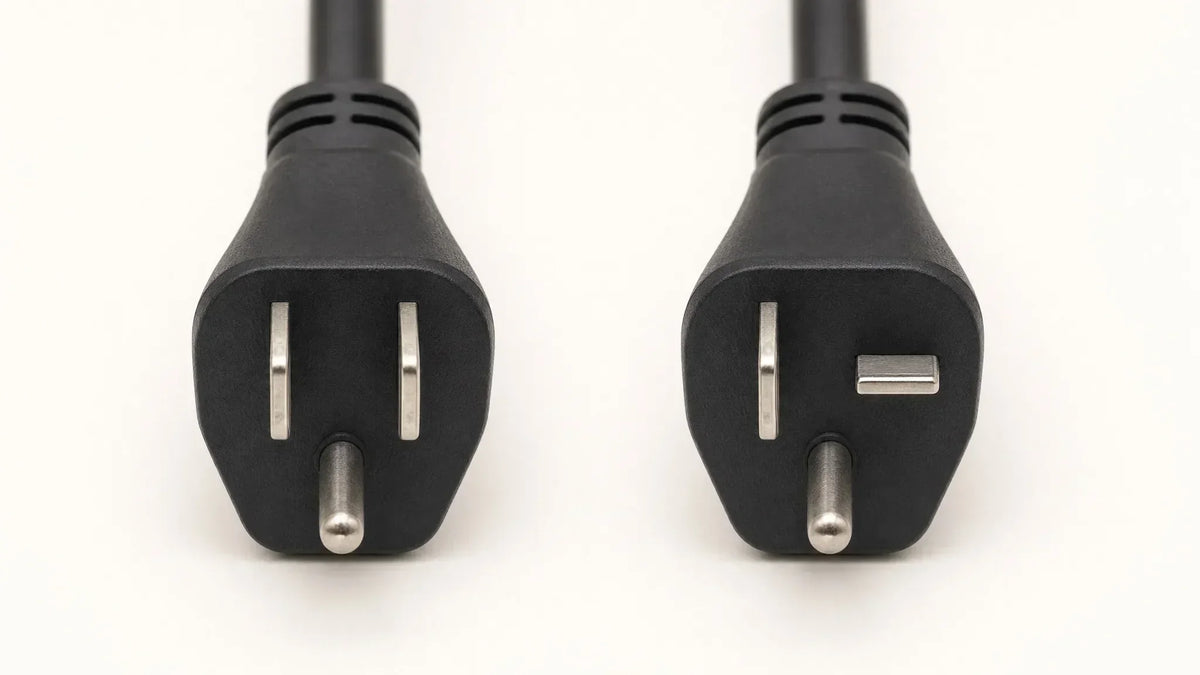
A standard U.S. household plug is a NEMA 5-15P. It has three prongs: two flat parallel blades (hot and neutral) and one round grounding pin below them. Every lamp, phone charger, and basic power strip you own uses this plug. It is rated for 15 amps maximum.
A NEMA 5-20P plug — the one that belongs on a real 20-amp power strip — has a critical difference: one of the two flat blades is rotated 90 degrees into a horizontal position, perpendicular to the other blade. The grounding pin stays round and below. This is not cosmetic. The horizontal blade is a physical interlock designed by the National Electrical Manufacturers Association to prevent a 20-amp device from being plugged into a 15-amp circuit that cannot safely supply it.
NEMA publishes these configurations in the WD 6 standard so that incompatible amperage and voltage combinations cannot be connected by accident. The National Electrical Code reinforces this in NEC 210.21(B), which requires that a receptacle's rating match or exceed the branch-circuit rating it serves.
The Wall Outlet Looks Different Too
A 15-amp wall receptacle has two vertical slots plus a round grounding hole below. A 20-amp wall receptacle replaces one vertical slot with a T-shaped opening — a vertical slot crossed by a short horizontal slot. That T-shape accepts both a 5-15P plug (parallel blades) and a 5-20P plug (one horizontal blade). The outlet's faceplate is the same ivory color and the same size; the difference is inside that T-slot.
On the power strip side, a real 20A strip uses NEMA 5-20R outlets — receptacles with the same T-shaped slot on the strip's face — so each outlet can accept either type of plug. A strip labeled "20 amps" that has standard vertical-only slots is a contradiction: its own receptacles do not even accept a 20A plug.
Where 20-Amp Circuits Live — and What Uses Them
If you have never seen a 20-amp residential outlet before, you are probably not looking in the right rooms. The National Electrical Code (NFPA 70) requires 20-amp branch circuits in several specific locations inside a typical American home.
In the Home
Under NEC 210.11(C) and 210.52(B), these areas must be served by at least one 20-amp small-appliance branch circuit — and often two:
- Kitchen countertop receptacles. Toasters, blenders, coffee makers, and microwaves can each pull 8–12 amps. Two running at once on the same 15-amp circuit will trip the breaker.
- Laundry rooms. Washing machines draw significant current on spin-up.
- Bathroom receptacles. Hair dryers and curling irons routinely pull 1,500 watts or more. A 20-amp GFCI-protected circuit is required.
- Garages. Power tools, battery chargers, and occasional high-draw portable equipment.
- Dedicated air-conditioner circuits. Window units rated at 12,000 BTU and above frequently ship with a 5-20P plug.
You can identify a 20-amp wall outlet instantly: it has the T-shaped neutral slot described above.
Devices That Ship with a 5-20P Plug
If a device leaves the factory with a NEMA 5-20P plug, the manufacturer has determined that its current draw warrants a 20-amp circuit. Common examples include:
- Large window air conditioners (12,000 BTU and above)
- High-output portable space heaters on the "high" setting
- Some cabinet-style table saws and stationary woodworking tools
- Welding machines in the 120-volt class
- Commercial kitchen equipment (countertop griddles, large mixers)
- High-wattage aquarium pump arrays and hydroponic lighting controllers
If you own one of these, you need a real 20A power strip — not because you want "heavy duty," but because your device's plug will not physically fit into a 15A strip.
The Amazon 20A Problem — 12 AWG Cord, Everything Else 15A
Search "20 amp power strip" on Amazon and you will see pages of products with titles like "20A Heavy Duty 12 AWG Power Strip, 8 Outlets, Metal Housing." The photos show a black strip with outlets on top. At $24.99, it looks reasonable. But look at the plug.
What the Listing Gives You
What changed: The cord. The manufacturer used a 12 AWG copper cord instead of the 14 AWG found on standard 15-amp strips. A thicker cord runs cooler at the same current, so the product can honestly say "12 AWG" — and many buyers stop reading there.
What did not change:
- The plug is still a NEMA 5-15P. Two parallel blades, one round ground pin. No horizontal blade.
- The internal bus bars are 15-amp gauge. The copper strips that carry current inside are thinner than 20A spec requires.
- The overload protection breaker is rated 15 amps. The resettable breaker is set to trip at roughly 15 amps — not 20.
- There is no NRTL certification. No ETL, UL, or CSA mark with a file number you can verify.
A power strip's safety ceiling is set by its weakest link. When the cord is 12 AWG but the plug, bus bars, and breaker are 15 amps, the strip is a 15-amp device wearing a 12 AWG coat.
You can verify any listing's claims yourself. Look for a certification file number printed on the product housing, then enter it into the UL Product iQ directory or the Intertek ETL directory.
5 Ways to Verify a 20A Power Strip Is Real
You do not need a multimeter or an engineering degree. Five checks, each confirmable from the listing photos and the product housing.
- Check the Plug Shape: Open the listing's product photos. Do you see one horizontal blade perpendicular to the other? If all blades are parallel, the strip is 15 amps.
- Look Up the Certification Number: Take the UL or ETL file number on the housing and search it in the respective online directory.
- Confirm the Overload Protection Rating: A legitimate 20A strip will have "20A" stamped or printed on the breaker housing.
- Read the Housing Label: A real 20A power strip will bear a label that reads "20A 125V" or "20A 125VAC."
- Ask for the Internal Specifications: Ask the seller for a specification sheet that states the internal bus bar and conductor ratings are 20A.
The Safety Risk — What Happens When a Fake 20A Strip Runs 18 Amps
Imagine you bought a "20A" power strip for a workshop setup: a table saw (12 amps) and a dust collector (6 amps). Together they pull 18 amps. You plug them into the strip via standard 5-15P plugs. The 12 AWG cord handles the load, but here is what happens at the weak points:
- At the plug: The brass blades run roughly 44% above their rated current. Thermoplastic around the blades softens at sustained temperatures above 60°C (140°F).
- Inside the strip: Resistive heating inside the sealed plastic housing has nowhere to go. The PVC insulation grows pliable.
- At the breaker: A 15-amp breaker may not trip immediately. The fire happens in the window between "everything is running hot" and "the breaker finally opens."
NEC 210.20(A) codifies the principle: an overcurrent protection device must be sized so that no component in the protected circuit operates above its continuous rating.
The Adapter Question — Can You Use a 20A Strip on a 15A Outlet?
Not directly. The horizontal blade on a NEMA 5-20P plug will not enter a standard 15-amp receptacle. A 15A-to-20A adapter bridges this gap, but the adapter must include its own 15-amp overcurrent protection. Without it, a 20A load on a 15A circuit will either trip the wall breaker or run the branch-circuit wiring dangerously hot.
Important: An adapter is a temporary solution while a licensed electrician installs a dedicated 20-amp circuit. It does not turn a 15-amp circuit into a 20-amp circuit.
What a Real 20A Power Strip Looks Like — The CRST 20A Spec Check
Here is the five-point verification applied to a single product line so you can see what passing all five looks like.
| Verification Check | CRST 20A Heavy-Duty Metal Power Strip |
|---|---|
| NEMA 5-20P plug with horizontal blade | ✅ Visible on every unit and product photo |
| ETL certification verifiable online | ✅ Listed to UL 1363 and UL 1449; file number searchable |
| 20A overload protection | ✅ Resettable 20-amp circuit breaker, marked on housing |
| Housing label rated 20A 125V | ✅ Metal enclosure, stamped and legible |
| Internal components rated 20A | ✅ ETL listing includes internal construction review for 20A rating |
Beyond the five checks, the strip carries 1,960 joules of surge protection under UL 1449, ships with a 6-foot 12 AWG cord, and uses eight NEMA 5-20R T-slot receptacles. The enclosure is aluminum, adding both impact resistance and a passive heat sink.
20A vs. 15A Heavy-Duty — Which One Do You Actually Need?
Decision Matrix
| Your Situation | Recommendation |
|---|---|
| Total load ≤ 12A continuous, no 5-20P devices | 15A heavy-duty power strip |
| Total load 12–16A continuous, or at least one 5-20P device | 20A power strip with ETL certification |
| Total load > 16A continuous | Dedicated 20A+ branch circuit installed by an electrician |
Frequently Asked Questions
How can you tell if a 20 amp power strip is real?
Look at the plug. A real 20A strip uses a NEMA 5-20P plug — one horizontal blade, one vertical, one round ground pin. Then verify the ETL or UL certification number on the housing against the Intertek or UL Product iQ online directory.
Can I plug a 20 amp power strip into a 15 amp wall outlet?
Not directly. A 15A-to-20A adapter with a built-in 15A overcurrent breaker allows temporary connection, but a dedicated 20A circuit is the correct permanent solution. Never use an adapter without overcurrent protection.
What appliances and tools use a 20A plug?
Large window air conditioners above 12,000 BTU, some table saws, portable welders, commercial kitchen mixers, and high-output aquarium pump systems commonly ship with NEMA 5-20P plugs.
Why do some 20A power strips still have a 15A-looking plug?
These listings upgrade the cord to 12 AWG but leave the plug as NEMA 5-15P (rated 15A), the internal bus bars at 15A gauge, and the breaker at 15A. It is a misrepresented product.
Where in a home are 20A circuits typically installed?
Under NEC rules, 20-amp circuits are required for kitchen countertop receptacles, laundry areas, bathroom GFCI outlets, and garages. You can identify a 20A wall outlet by the T-shaped slot.
What CRST Recommends
If the decision matrix above puts you in the 20A column, the CRST 20A Heavy-Duty Metal Power Strip passes each of the five verification checks. It is built with a 12 AWG cord, a NEMA 5-20P plug, eight NEMA 5-20R T-slot outlets, and a 20A resettable breaker inside an aluminum enclosure. The included 15A-to-20A safety adapter means you can plug in today.
If your load math comes out below 12 amps and none of your devices carry a 5-20P plug, the CRST 6-Outlet Heavy-Duty 15A Strip (6A450) is the simpler certified choice — same metal enclosure, same certification rigor, fewer dollars.
Power gear that matches the advice.
Certified by an OSHA-recognized NRTL — ETL/SGS · UL1363 & UL1449. Full-gauge copper — 14AWG on 15A models, 12AWG on 20A. 18-month warranty, free extension to 36 months on registration.
0 Comments