

Is Daisy Chaining Power Strips Illegal? OSHA & NEC Rules
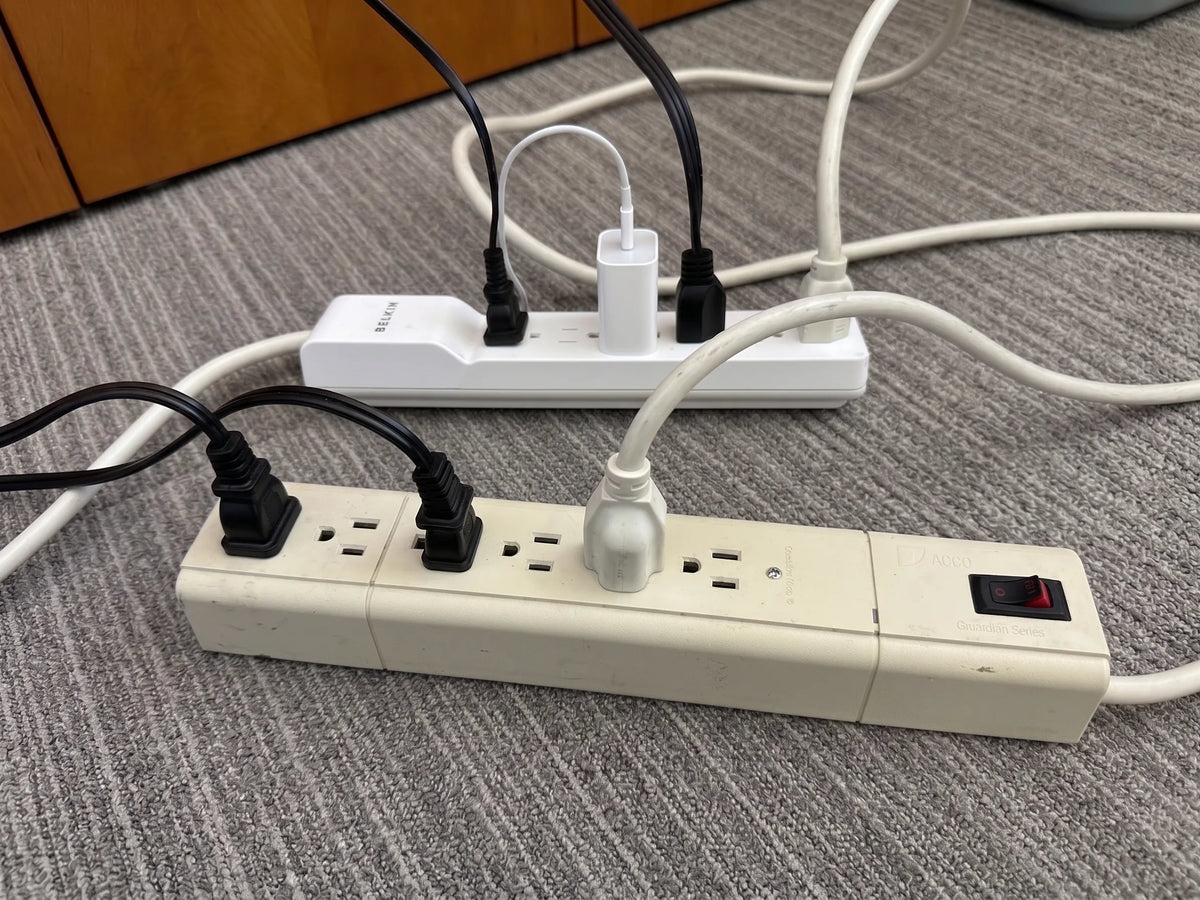
Daisy chaining power strips—plugging one strip into another, or into an extension cord—violates OSHA 29 CFR 1910.303(b)(2), breaks the listing conditions set by UL 1363 §1.7, and conflicts with NFPA 1 Chapter 11. It concentrates current at a single 15-amp wall outlet and invites overheating long before any breaker trips.
Introduction
Most American offices have at least one: a power strip plugged into another power strip, stretched behind a desk to reach a printer. It looks harmless. It is not. Daisy chaining power strips violates OSHA 29 CFR 1910.303(b)(2), breaks the listing conditions set by UL 1363, and pushes a single branch circuit past the limits it was designed for.
This guide lays out what the codes actually say, why the physics punishes daisy chains even when the wall outlet seems "fine," and what to do instead when you run out of receptacles.
What "Daisy Chaining" Actually Means (And the Mixed Variant)
Daisy chaining is the practice of plugging one relocatable power tap (RPT)—the technical name for a power strip under UL 1363—into another RPT. Plugging a power strip into another power strip is the most common pattern, but the same logic applies to plugging a strip into an extension cord, or an extension cord into a strip. When different device types are combined, the industry calls it a mixed daisy chain. Some people call it "piggybacking." The codes treat all three the same way.
The UL standard is explicit. UL 1363 §1.7 states: "A cord-connected RPT is not intended to be connected to another cord-connected RPT." That single sentence is the basis for most of the rules that follow. Per UL's current General Information for category XBYS (Relocatable Power Taps), the same restriction is reiterated in product listings today. When you daisy chain, you leave the conditions under which the strip was tested and certified.
Is Daisy Chaining Power Strips Illegal? What OSHA, NEC, and NFPA Say
Three separate code bodies cover this question, and they reinforce each other. If you only remember one, remember OSHA.
OSHA 29 CFR 1910.303(b)(2) — The Listing Condition Rule
OSHA 29 CFR 1910.303(b)(2) is short and sharp: "Listed or labeled equipment shall be installed and used in accordance with any instructions included in the listing or labeling." Because every UL-listed power strip carries instructions that forbid series connection, daisy chaining violates this rule by default.
OSHA reinforced the point in a Letter of Interpretation titled "Compliance requirements for relocatable power taps or 'power strips'". The letter reiterates that UL-listed RPTs must be connected directly to a permanently installed branch-circuit receptacle, and that they are not intended to be series-connected to other RPTs or supplied through extension cords. That is as close to a direct prohibition as OSHA gets on this topic.
Strictly, OSHA applies to workplaces. However, insurers, home inspectors, and local fire marshals routinely treat OSHA and UL listing conditions as the reasonable-use benchmark for residential settings too.
NEC — Flexible Cord Is Not a Substitute for Wiring
The National Electrical Code (NFPA 70), adopted in nearly every U.S. jurisdiction, restricts how flexible cord can be used. Under NEC 400.12 (formerly 400.8 prior to the 2023 renumbering), flexible cord and cable must not be used as a substitute for the fixed wiring of a structure, run through holes in walls or ceilings, or used where concealed by building finishes. Daisy chaining often violates both the "no substitute for wiring" principle and the physical routing rules.
NFPA 1 — The Fire Code for RPTs
NFPA 1, the Fire Code, addresses relocatable power taps directly in Chapter 11 (§11.1.4 in recent editions). The exact section numbering has been consistent since the 2015 edition, but you should always check the current edition adopted in your jurisdiction. The substance has not changed:
- RPTs must be polarized or grounded, have overcurrent protection, and be listed.
- They must be directly connected to a permanently installed receptacle.
- RPT cords must not run through walls, ceilings, floors, under doors, or under floor coverings.
In short, the three bodies say the same thing three ways: a power strip is certified for one use case—direct connection to a fixed wall outlet—and nothing else.
Why Daisy Chaining Power Strips Causes Fires (The Physics)
The codes exist because the physics is unforgiving. A standard U.S. branch circuit receptacle delivers 15 amps at 120 volts, or 1,800 watts total. No amount of chaining changes that ceiling. You can plug in 12 more outlets by linking two 6-outlet strips. But every electron still passes through the same 15-amp wall receptacle and the same strip cord behind it.
When the downstream load creeps past 12 amps (the 80% continuous-use benchmark) the cord insulation heats up, the internal breaker trips if you are lucky, and the contacts arc if you are not. The Office of Congressional Workplace Rights Fast Facts notes that most power strips are listed for four to six devices; chaining two of them routinely runs the first strip past its rating.
Cord length adds a second penalty. Electrical resistance rises with length, and I²R losses show up as heat. Two strips with 6-foot cords in series behave like a single 12-foot cord of the thinner of the two conductors—except the connection points in the middle add contact resistance of their own. That plug-and-socket joint is where most power strip overload fires start: not inside either strip, but at the seam between them.
Chaining surge protectors deserves a separate warning. Joule ratings do not add when you plug one surge protector into another. The clamping circuits behave unpredictably when stacked, and the downstream device can actually see a larger residual spike than a single correctly-sized unit. There is no redundancy benefit here, only violated listing conditions.
The Safe Alternative — Size One Heavy-Duty Power Strip for Your Load
Most daisy chains exist because someone has 10 things to plug in and four wall outlets to work with. The correct fix is almost always "one bigger strip on a sufficient circuit," not "two smaller strips in a row." Here is how to size it.
Do the Math (Σ Watts ÷ 120 V)
Add up the nameplate wattage of everything you plan to run at the same time, then divide by 120 V.
Example for a home office:
- 27-inch monitor: 60 W
- Mini desktop PC: 200 W
- Two USB chargers: 30 W each → 60 W
- Laser printer (idle): 20 W; (active): 500 W
- Desk lamp (LED): 10 W
- Total, worst case: 850 W ÷ 120 V ≈ 7.1 A
The rule of thumb: keep continuous load under 80% of the circuit rating. On a 15-amp circuit, that means 12 amps, or about 1,440 W. The example above lives comfortably inside that limit. This derives from NEC 210.20(A), which requires a branch-circuit overcurrent device to be rated at no less than 125% of the continuous load.
If your total exceeds 12 amps, no power strip will solve it. You need a second branch circuit, installed by a licensed electrician.
What "Heavy Duty" Actually Means on the Spec Sheet
Not every strip labeled "heavy duty" earns the name. Check for:
- 14 AWG cord, not the common 18 AWG found on cheap consumer strips. Thicker copper runs cooler under load.
- Resettable 15-amp overload breaker, so a brief surge does not force you to throw the strip away.
- Metal enclosure rather than thin ABS plastic, which resists crushing and adds a heat sink.
- Individual outlet switches so idle equipment draws no standby current—a small fire-risk reduction and a real phantom-load cut.
- UL 1363 listing from a Nationally Recognized Testing Laboratory (UL Solutions, Intertek/ETL, or CSA).
Pick a strip that meets all five and the daisy chain behind your desk can be replaced by a single, code-compliant device. If you want a starting point, the CRST heavy-duty power strip collection groups models built to these specs.
When You Truly Need More Outlets
Sometimes the honest answer is that a power strip is the wrong tool.
OSHA 29 CFR 1910.305(g) treats flexible cords as temporary wiring. OSHA has long held, via enforcement practice and field bulletins in general industry, that flexible cords used in place for more than 90 days should be replaced with fixed wiring. Construction-site rules differ and do not impose the same fixed 90-day threshold. NEC is even stricter: under NEC 400.12, flexible cord cannot substitute for the wiring of a structure at all.
A short decision tree:
- Load under 12 amps, temporary setup under 90 days → one heavy-duty UL 1363 strip, plugged directly into the wall.
- Same location, every day, for the foreseeable future → call a licensed electrician and add a receptacle.
- High-draw equipment (space heaters, large printers, shop tools) → dedicated branch circuit, hard-wired. Power strips are explicitly not the answer here.
If you are unsure which category you are in, talk to a licensed electrician. The consultation usually costs less than one insurance deductible.
Frequently Asked Questions
Q1: Is daisy chaining power strips illegal in homes?
A: OSHA regulations apply to workplaces, but UL 1363 §1.7 and NFPA 1 Chapter 11 define daisy chaining as misuse of the listing, so home use still breaks the conditions under which your power strip was certified. Insurers and local fire codes often reference these same standards.
Q2: Can you daisy chain surge protectors safely?
A: No. Plugging a surge protector into another surge protector voids the listing conditions and does not add protection. Joule ratings do not stack, and the clamping circuits can interfere with each other. UL 1363 §1.7 and the UL Product iQ listing for Relocatable Power Taps (category XBYS) explicitly prohibit the arrangement.
Q3: How many power strips can I plug into one wall outlet?
A: One UL-listed relocatable power tap per wall receptacle, connected directly. Not one through another. The wall outlet's 15-amp capacity is the ceiling, and additional power strips do not add capacity—they only add points of failure.
Q4: What should I use instead of daisy chaining at the office?
A: Add a properly sized heavy-duty power strip within the 12-amp safe limit, or—if the need is permanent—have a licensed electrician install an additional branch-circuit receptacle. In general industry, temporary cords left in place longer than 90 days typically need to be replaced with fixed wiring under OSHA enforcement practice.
What CRST Recommends
If your total load comes in under 12 amps and you want to replace a daisy chain with a single compliant strip, look for these five things on the spec sheet: UL 1363 listing, 14 AWG cord, a resettable 15-amp overload breaker, a metal enclosure, and individual outlet switches so unused equipment draws no standby current.
The CRST 6-Outlet Heavy Duty Power Strip (model 6A450) meets each of those conditions. It ships with SGS certification to UL 1363 and UL 1449, a 14 AWG cord, a 1,200-joule surge-protection stage, and six individually switched outlets in a metal housing—built for the high-density home-office and shop setups where daisy chains tend to appear in the first place.
Power gear that matches the advice.
Certified by an OSHA-recognized NRTL — ETL/SGS · UL1363 & UL1449. Full-gauge copper — 14AWG on 15A models, 12AWG on 20A. 18-month warranty, free extension to 36 months on registration.
0 Comments